A pilgrimage to Lourdes unfolds in three stages: discerning your intentions, preparing your prayer and choosing your moment before departure; welcoming the grace of the place once there; letting what you have received bear fruit on your return.
How to Prepare Your Pilgrimage to Lourdes?
The spiritual and practical guide by Saint Bernadette's family
In a few words
The meaning of a pilgrimage to Lourdes
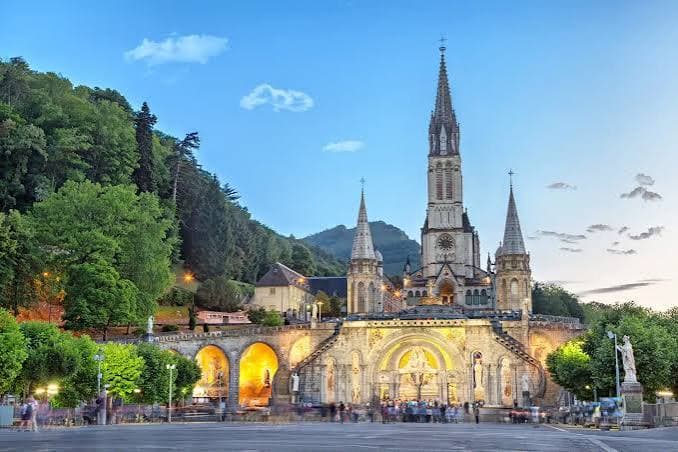
Since the Virgin Mary first appeared to Bernadette Soubirous at the grotto of Massabielle, on 11 February 1858, millions of pilgrims from every country and every walk of life have made their way to Lourdes.
A pilgrimage is never an ordinary journey: the physical displacement opens an inner one, towards a grotto on the banks of the Gave where a fourteen-year-old girl, sick, illiterate and undernourished, saw the Virgin eighteen times between 11 February and 16 August 1858.
Our family, direct descendants of the Soubirous through Jean-Marie, Bernadette's brother, has been welcoming pilgrims to the Maison Paternelle for more than 150 years.
Before departure: preparing inwardly
The preparation begins in the heart, before the suitcase.
Discerning your intentions
Why are you coming to Lourdes? In prayer or in silence, identify what you are carrying: a request for yourself or a loved one, a grace to receive, a reconciliation, a grief, a decision to clarify, a thanksgiving. Write it all down in a notebook or on a sheet slipped into your missal — writing fixes the intention — and once in Lourdes you will be able to measure the distance travelled.
Remember what the Virgin asked of Bernadette on 24 February 1858, at the eighth apparition:
“Penance! Penance! Penance!”
Not a sad penance, but an inner conversion: the horizon of every pilgrimage.
Preparing your prayer
Put together your prayer notebook: the psalms you love, the Marian antiphons (the Ave Maria of Lourdes, the Magnificat, the Sub Tuum Praesidium), the names of those you are praying for. A novena begun nine days before arrival prepares the soul; novenas to Saint Bernadette and to Our Lady of Lourdes are available in religious bookshops or through your parish. Bring your rosary beads or an olive-wood rosary, your missal or prayer book — the ones that already accompany you day by day, no new aids.
Choosing your moment
Each season has its own grace. Spring (early April to late June): soft light and mild temperatures, and the return of the evening torchlight procession. Summer (July-August): the great international pilgrimages, large crowds but a unique experience of universality, in dozens of languages. Autumn, especially September: mild weather, beautiful Pyrenean colours, quieter crowds. Winter: intimacy and silence, with beautiful celebrations in the cold every 11 February, echoing the icy winter of 1858.
Booking your stay
Book your accommodation several weeks in advance, especially for the great Marian feasts (11 February; 25 March, the Annunciation; 15 August, the Assumption; 8 December, the Immaculate Conception), Pentecost and the diocesan pilgrimages of July and August. Options range from hotels to guest houses run by religious congregations, more modest but close to the spirit of the pilgrimage. If you are coming as a group, let the Sanctuary know several months in advance for dedicated slots: international Masses, baths, processions, a meeting with a priest. Also book your visit to the Paternal Home to avoid the wait.
During the pilgrimage: welcoming the grace of the place
Let Lourdes speak to you at its own pace: the daily liturgy of the Sanctuary has accompanied pilgrims for more than a century.
A typical pilgrim's day in Lourdes
Around 7 am, begin at the grotto, almost deserted — without doubt the most beautiful moment of the day. At 9:30 am, the international Mass in the underground basilica of Saint Pius X: pilgrims from every continent, the Gospel in several languages. Then the monumental Way of the Cross behind the basilica: fifteen life-size bronze stations, about an hour and a half in a penitential spirit.
At 5 pm in summer, the Eucharistic procession sets off from the grotto: the Blessed Sacrament crosses the esplanades with the sick and the pilgrims, up to their blessing before the altar. Around 6 pm, a more intimate Mass at the Sainte-Bernadette basilica. At 9 pm, from April to October, the torchlight procession makes its way from the Prairie to the grotto: thousands of pilgrims, candle in hand (buy yours before setting off), sing the Ave Maria of Lourdes in several languages.
The grotto of Massabielle at daybreak
Everything begins at the grotto of Massabielle on 11 February 1858, when Bernadette sees “the Lady” for the first time. At dawn, as the sun rises over the Pyrenees, sit facing the niche of the statue, at the exact spot of the apparition; touch the rock, entrust your written intentions.
On 25 February 1858, at the ninth apparition, the Lady asks her to dig the earth with her hands: water springs up, and it still flows — more than 100,000 litres a day for 167 years. Ordinary water, with no chemical virtue, but water that speaks of faithfulness. Drink it, splash it on your face: one of the three gestures the Virgin asked for, noted by her confessor, Father Peyramale:
“go drink at the spring and wash in it”
The baths and the spring
Welcomed by volunteer hospitallers, men and women, with great discretion, you immerse yourself for a few seconds, alone in a cubicle, in the cold water of the spring: a purification in the image of baptism — a symbolic death to sin, a renewed life. Many come out with a deep peace. Times vary: ask at the Sanctuary's welcome office.
The sacrament of reconciliation
Many pilgrims make confession the summit of their stay: the most precise and most liberating expression of the threefold call to penance.
Eucharistic adoration
The adoration chapel is open several hours a day, in total silence, before the Blessed Sacrament: for many, the intimate refuge of the stay, the counterpoint to the great liturgies.
The Maison Paternelle de Sainte Bernadette
No pilgrimage is complete without the places where Bernadette lived, starting with the Paternal Home at the Moulin Lacadé, 2 rue Bernadette Soubirous. Her father François lived here until his death on 4 March 1871; her mother Louise died here, in the kitchen, on 8 December 1866; on a chair still in its place, Bernadette fainted in the arms of her dying mother before her final departure for Nevers in July 1866.
Our family, the sixth generation, has kept the place intact for 154 years. There you will see the relics Bernadette made or used: the christening gown embroidered in Nevers for the first child of her brother Pierre, whose godmother she was (most recent baptism: September 2024), letters to Jean-Marie, her personal missal, a handkerchief, a small grotto carved out of coal in memory of Massabielle, holy cards made by her own hands.
Coming here means touching Bernadette's humanity — not the saint of the holy cards, but a poor, courageous, fragile and luminous girl — and paying tribute to François and Louise, whose simple faith shaped her own.
After the pilgrimage: letting the grace you have received bear fruit
Bringing home Lourdes water
Bring back bottles of water from the spring, for yourself, for loved ones who could not come, or for your parish. Without any magic power, this water is a sign that recalls the grace lived at the grotto: place it somewhere visible, sprinkle it on those you entrust to Our Lady.
Bearing witness and passing it on
When you return, people will ask you: “What was it like? What did it bring you?” Do not rush: a deep experience sometimes takes months to unfold. Speak with sobriety, without dramatisation or ostentatious piety; bear witness to what you saw, heard and received — not to what is expected of you.
Continuing to pray day by day
The daily rosary is a natural extension of the pilgrimage — the Lady prayed hers in silence before Bernadette. Regular reading of the Word, more frequent Mass if possible, reconciliation, faithfulness to your parish: all ways of letting what Lourdes gave you bear fruit.
The Virgin's three requests to Bernadette: a guiding thread
Three requests of the Virgin, in 1858, contain the whole meaning of the pilgrimage:
- Doing penance for the conversion of sinners. Not a punishment, but a return to God: inner preparation, reconciliation, renewed faithfulness.
- Going to drink at the spring and wash in it. Inner purification, from the fountains and the baths to the water brought home.
- Telling the priests to have a chapel built and to come in procession. The pilgrimage belongs to the visible Church, not to a private devotion: liturgy, procession, communion with others — never a purely personal affair.
FAQ — Your questions about the pilgrimage to Lourdes
How many days do you need for a pilgrimage to Lourdes?
At least three days for a first pilgrimage, five to seven for a deeper one.
When is the best time to go to Lourdes?
May-June and September: mild climate, moderate crowds. The great Marian feasts, spiritually powerful, are very busy. The Paternal Home is open from April to October, with occasional openings in winter, notably on 11 February.
Should you join an organised pilgrimage or come individually?
Both work: a diocesan or parish pilgrimage offers a fraternal setting, dedicated liturgies, spiritual accompaniment and lighter logistics; coming individually or as a family gives more flexibility.
How do you go to confession in Lourdes?
At the Chapel of Reconciliation in the Sanctuary: priests all day long, several languages indicated by signs, no appointment needed.
What should you say to the Virgin at Lourdes?
Speak simply, as to a mother: present your intentions, entrust those you carry, ask. Above all, listen: a pilgrimage is not a prayer you recite, it is a presence you receive.
Is the water of Lourdes free?
Yes, it flows freely at the public fountains of the Sanctuary, as many bottles as you wish; bring your own containers or buy some from the official shops.
Should you visit the Paternal Home during a pilgrimage?
Yes: our family welcomes you there in person, among Bernadette's relics.
What should you do with the experience of the pilgrimage once home?
Continue the practices you lived there: the rosary, reconciliation, reading the Word, Sunday Mass, parish communion.
To go further
Discover the full life of Saint Bernadette.
Immerse yourself in the account of the 18 apparitions of Lourdes.
Visit the Paternal Home at the Moulin Lacadé.
See the authentic relics preserved by our family.
Prepare your stay: practical information, a one-day itinerary, a two-day itinerary or a three-to-four-day itinerary.
Our invitation
Preparing for a pilgrimage means preparing to receive without knowing exactly what: it is in that surrender that it finds its depth.
Come and see us at the Moulin Lacadé: we have been welcoming pilgrims since Pierre, Bernadette's brother and godson, as early as 1872 — six generations on, the transmission continues.
Maison Paternelle de Sainte Bernadette · 2 rue Bernadette Soubirous, 65100 Lourdes · April-October: 9:30 am-12:15 pm / 2:15-6:30 pm · Upkeep contribution: €2.50
Begin your pilgrimage where it all began
The family home welcomes you before or after the Sanctuary, all season long.
or call us on 05 62 94 22 51