The relics kept at the Maison Paternelle in Lourdes are unique in the world: a christening gown embroidered in Nevers, handwritten letters to her brother Jean-Marie, her missal, a checked handkerchief, a small grotto carved out of coal, holy images. All were touched, made or worn by Bernadette Soubirous herself; our family has passed them down for six generations.
The Relics of Saint Bernadette at the Paternal Home in Lourdes
Six objects unique in the world, kept by our family for six generations
What are the relics of Saint Bernadette in Lourdes?
A collection no one else possesses
These objects are kept at the Moulin Lacadé, where her father François lived until his death on 4 March 1871. Bernadette died in Nevers on 16 April 1879, aged 35; for nearly 150 years, six generations, from her brother Jean-Marie down to us, her great-great-grandnephews and grandnieces, have watched over these objects.
The christening gown Bernadette embroidered at the convent in Nevers
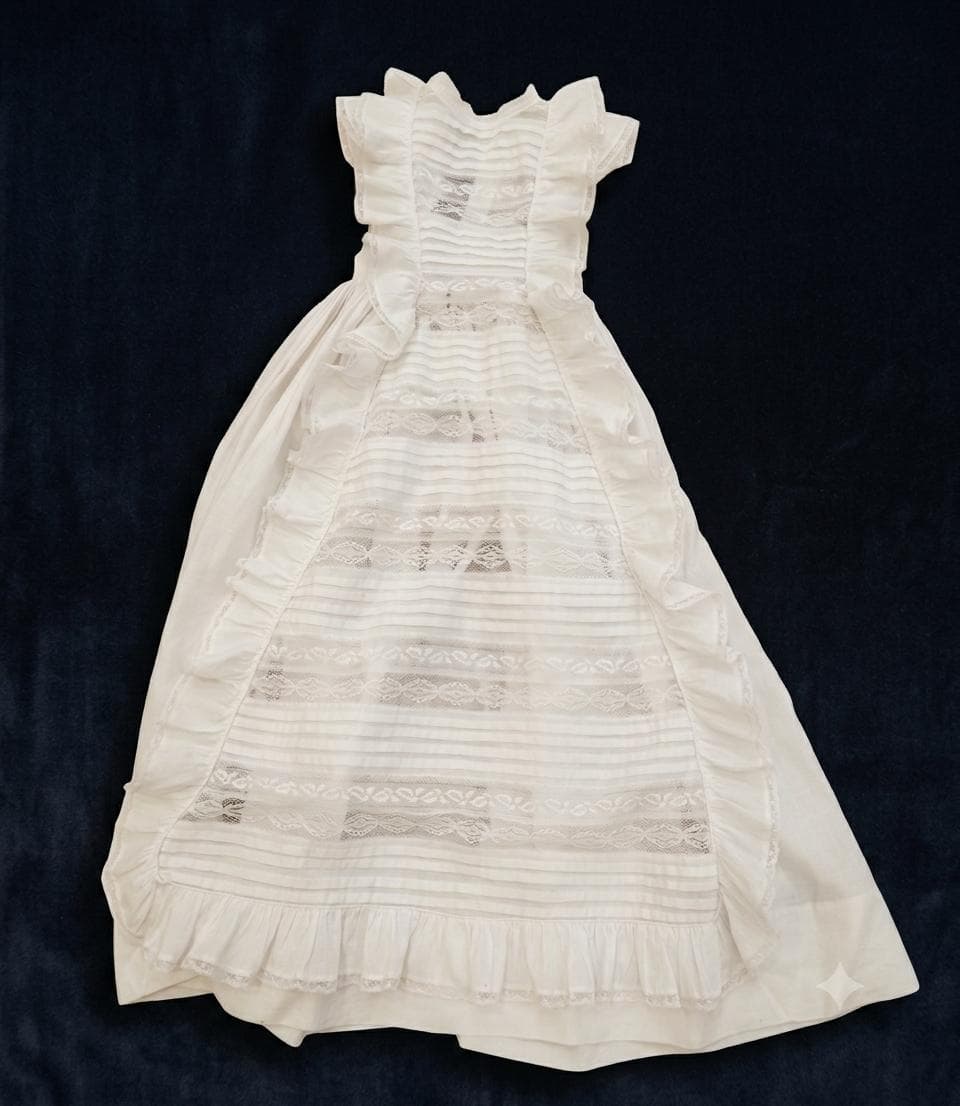
Bernadette embroiders this gown at the convent of Saint-Gildard for the first child of her brother Pierre, and sends it to him with these words:
“For the baptisms of your children.”
Embroidery done with precision
She could not read, write or embroider; she spoke Bigourdan, gathered wood and tended sheep in Bartrès, in the days of the Cachot (1857-1858). In Nevers, the sisters teach her everything, despite her asthma and the bone tuberculosis in her knee. A fine needle, thread, white linen: from her fragile fingers comes embroidery that is precise, careful, without a flaw.
A gown passed down through six generations
Pierre's children all die in infancy; the gown could have disappeared, but the family keeps it for the baptisms of the other Soubirous branches. The most recent: September 2024, a Soubirous baby, a century and a half after Bernadette set down her needle.
What you will see behind the glass
Under glass: white fabric slightly yellowed, neat and regular embroidery. Dozens of Soubirous babies have worn it. This gift from a sister who knew she would never see her family again says: I am no longer there, but I am watching over you.
Bernadette's handwritten letters to her brother Jean-Marie
From Nevers, Bernadette writes to her family. We keep a letter to her brother Jean-Marie: firm, perfectly formed handwriting, without a single mistake — from a girl who was completely illiterate eight years earlier, when she was seeing the Virgin at Massabielle.
The late education of an illiterate girl
Before entering the novitiate in July 1866, she could barely sign her name and had no command of French. In Nevers she learns, slowly, seriously: a calm, careful hand, with no trace of her constant physical suffering.
A simple, sisterly letter
News, her loved ones, union in prayer; no theology, no apparitions. Written not to become a relic, but by a sister to her brother — that very ordinariness is what moves you.
What you will see
Yellowed paper, sepia ink, under glass. Nothing of the working-class girl you would imagine in 1860: direct proof of what she learned in Nevers.
The little coal grotto carved by Bernadette
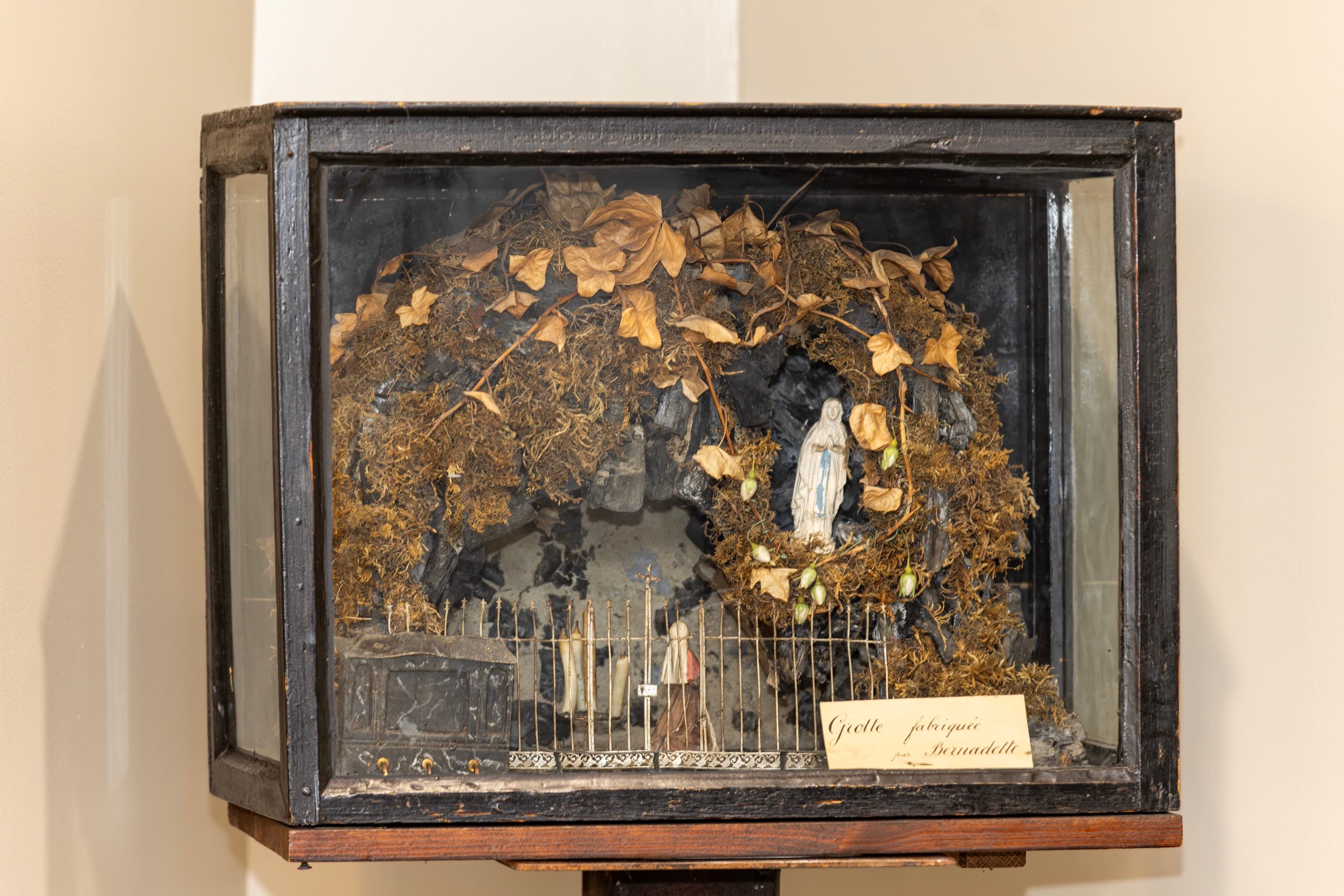
The humblest, most moving object of all: a grotto carved out of coal by Bernadette, probably in memory of Massabielle, where the Virgin appeared to her eighteen times between February and August 1858.
A childhood gesture, not a saint's gesture
She carves the coal that was burned in the fireplace of the Cachot, despite the destitution: a hollowed cavity, a shaped rock, Massabielle reproduced in miniature, just as she saw it. Not a work of art — the gesture of a teenager bringing something too great for her back down to a child's scale.
Why this object moves visitors so deeply
Many people stop here longer than before the gown, the letters or the missal. No golden reliquary, no silk: a lump of coal blackened by the fingers of a girl of the people, almost nothing — like Bernadette, daughter of a ruined miller, asthmatic, illiterate, who saw the Virgin.
What you will see
On a stand, behind glass: black coal, gleaming in places; a cavity, a rock, the silhouette of Massabielle. Irregular edges cut by a teenager's hand — at the Cachot, or at the Moulin Lacadé after 1865.
Bernadette's personal missal
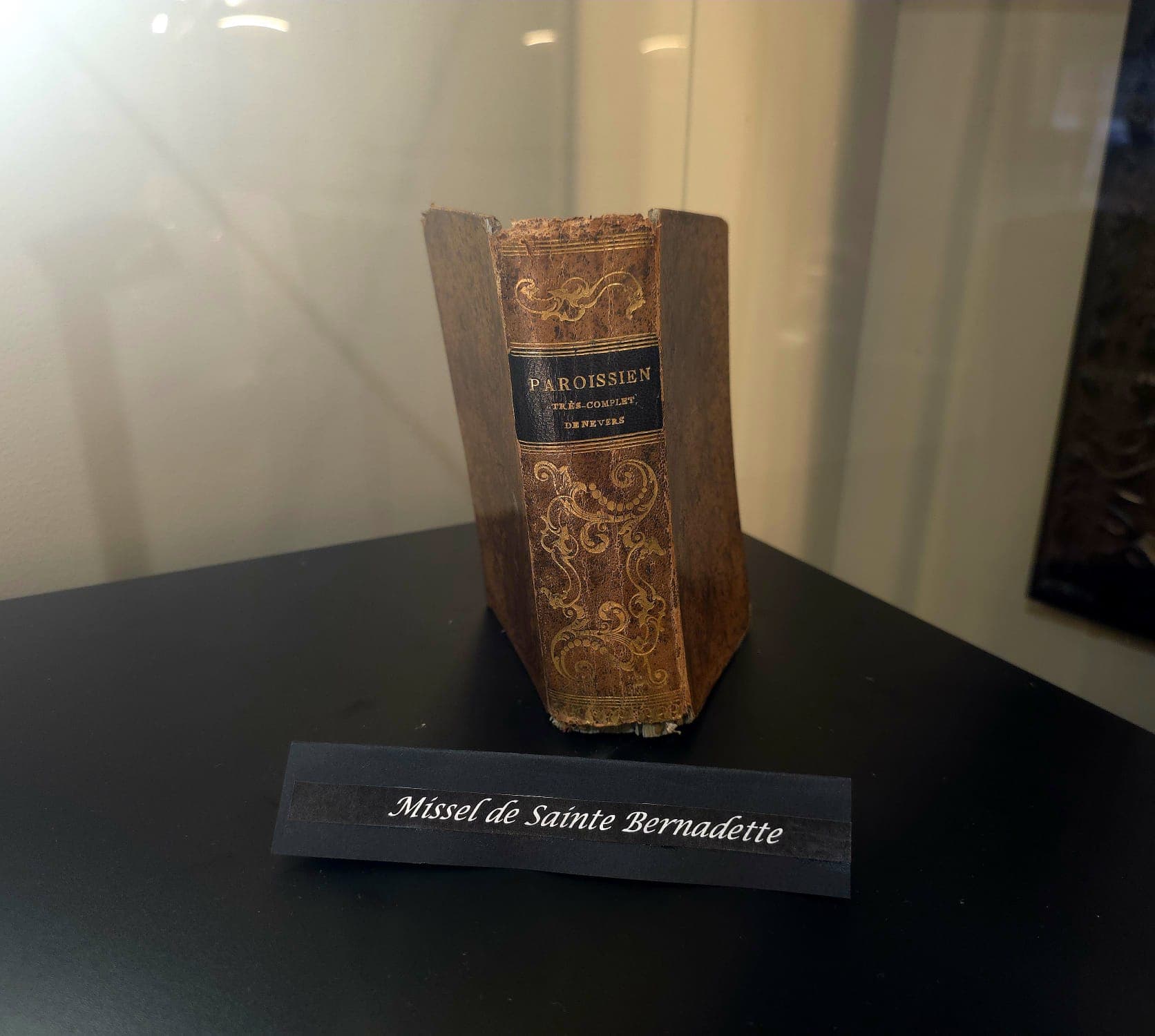
This missal was hers: pages turned, dog-eared, marked by use.
An everyday book, not a ceremonial one
Every nun and practising family of the nineteenth century had one; this one is hers. Opened before Mass, followed during the liturgy, closed before Compline, it accompanied her prayers, in Lourdes then in Nevers, until the end.
What you will see
A dark cover worn smooth, faded gilt edges, blunted corners. Hands, feverish or at peace, clung to it as to a companion.
Bernadette's little checked handkerchief
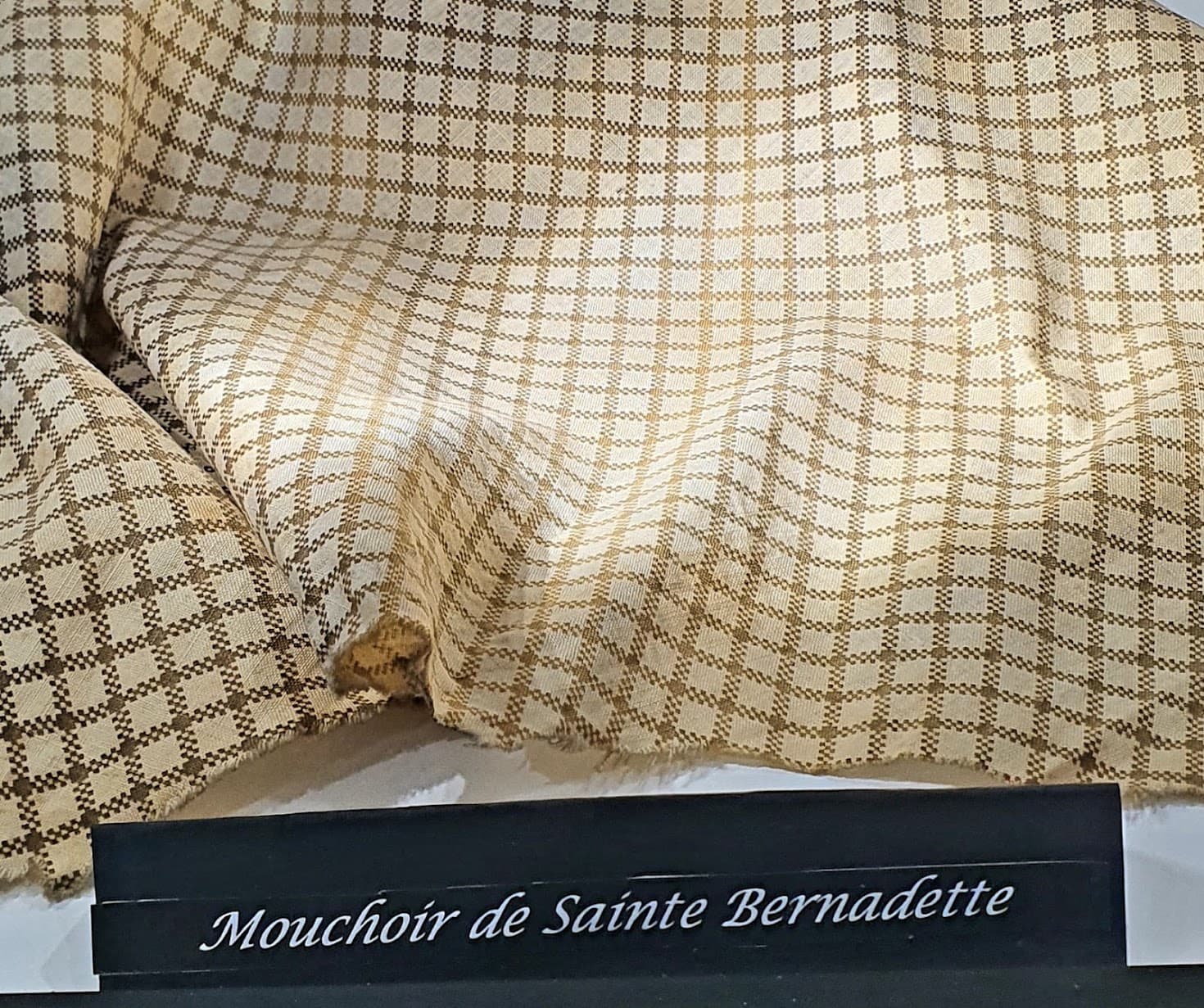
An ordinary object, indispensable at the time, of the kind made in the families of Bigorre in the nineteenth century. Bernadette kept it on her.
A detail that brings us back to the human
Bernadette was a sick young woman, asthmatic since childhood. Neither a liturgical relic nor an object of devotion: the object of a body that coughs, blows its nose, wipes its face, sweats through fevers.
Why it is precious all the same
Precisely because it is ordinary. This cotton passed over her forehead when the fever rose proves that the saint we pray to was first of all a girl of flesh and blood — not a stained-glass figure, but the one the Virgin chose.
The holy images made by Bernadette
Bernadette also made small holy images, in her free time, to give away or for herself.
Patient work
The Sisters of Charity of Nevers devoted part of their days to manual work: sewing, embroidery, images for pilgrims or poor parishes. Bernadette cuts, assembles, sometimes adds colour. A few of these images have come down to us, protected from light and damp.
What you will see
Modest images: paper, colour, sometimes a thread or a ribbon — but her hand cut, glued and placed every detail.
Why these relics have stayed in our family for six generations
When she leaves for Nevers in July 1866, Bernadette leaves very little behind: worn clothes, small objects, and what she sends from the convent — the gown, letters, images. All of it comes to Jean-Marie, who inherits the Paternal Home at François's death in 1871.
Jean-Marie, the first guardian
Bernadette is already famous, Lourdes is drawing its first pilgrims: Jean-Marie understands the spiritual and historical value of these objects. Collectors and churchmen seek donations for bishoprics or shrines. He refuses, keeps everything, passes it on to his son.
Six generations of transmission
His son inherits, then his grandson, his great-granddaughter, then us. With each generation, the same rule, never written down, handed on by example: keep everything, protect everything, pass everything on — tomorrow, to the children of the next generation.
Why this family transmission is unique
The Moulin Lacadé has remained private and in the family: since 1871, the house has been handed down within the Soubirous family, from generation to generation, without ever leaving the hands of her descendants. That is what makes this transmission unique: here, Bernadette's objects have stayed in the very house where her family lived.
How to see the relics of Saint Bernadette in Lourdes
They are displayed in a room adjoining the Moulin Lacadé, open every day from April to October.
Allow 15 to 20 minutes for the visit: the paternal home, the bedrooms in their original state, the relics room.
- Address
- 2 rue Bernadette Soubirous, 65100 Lourdes
- Opening hours from April to October
- 9:30-12:15 / 14:15-18:30
- Upkeep contribution
- €2.50 (groups: €2.00 per person from 15 people)
- Free of charge
- children under 16, religious and priests, group leaders, visitors with disabilities
Frequently asked questions about the relics of Saint Bernadette
What are the authentic relics of Saint Bernadette in Lourdes?
The christening gown embroidered in Nevers, handwritten letters to her brother Jean-Marie, her personal missal, the checked handkerchief, the small coal grotto carved in memory of Massabielle, and holy images made by her own hands.
Where can you see the relics of Saint Bernadette in Lourdes?
At the Maison Paternelle de Sainte Bernadette, 2 rue Bernadette Soubirous in Lourdes. Open from April to October, 9:30-12:15 / 14:15-18:30; contribution: €2.50.
Why are these relics kept at the Paternal Home?
Because the Soubirous family, direct descendants of Jean-Marie, keeps them. At her death in 1879, Bernadette left only a few objects, sent from Nevers to her family; they have remained in the paternal home, handed down within the family for six generations.
Is the christening gown embroidered by Bernadette still used today?
Yes: it is still used for the baptisms of children in the Soubirous family. The most recent took place in September 2024.
Can you photograph the relics?
Yes, in the paternal home; flash photography is forbidden in the relics room, to preserve the christening gown, letters and images.
To go further
Discover the life of Bernadette Soubirous, told by her family
Read the account of the 18 apparitions of Lourdes, seen from inside the family
Visit the Paternal Home at the Moulin Lacadé, kept intact since 1871
Prepare your visit: Practical information
For pilgrims: Preparing your pilgrimage to Lourdes
Our invitation
These relics are not in the display case of a municipal museum. They are in our home: the house where François lived, where Louise died on 8 December 1866, where Bernadette came to say goodbye to her mother before leaving forever for Nevers.
Most often it is Anne who will welcome you, great-great-grandniece of Bernadette, the sixth generation to watch over these objects. We are not museum curators, we are a family: these relics are our inheritance, spiritual and familial. Come and see them.
Maison Paternelle de Sainte Bernadette — Moulin Lacadé, 2 rue Bernadette Soubirous, 65100 Lourdes
See these places and objects with your own eyes
The christening gown, the letters, the missal: everything can be seen in the house, presented by the family.
or call us on 05 62 94 22 51